U.S. Crude Supplies 27.5% of Japan's September Oil Imports as $80 Million Tankers Test Asia Trade
American oil is now Japan's second-largest source after the UAE, and Kpler expects Americas arrivals in Asia to jump in November, even as supertanker rates squeeze the trade.
What to know
- The United States supplied 15.98 million barrels, or 27.5%, of Japan's 58.18 million barrels of crude imports in September, behind only the UAE, according to METI trade data.
- Kpler expects Asia's crude imports from the Americas to rise to 6.29 million barrels a day in November from 4.16 million in October.
- Chartering a supertanker to move 2 million barrels of U.S. Gulf crude to China cost about $80 million in early October, or about $40 a barrel versus $8.60 before the war.
HOUSTON
American crude supplied 27.5% of Japan's oil imports in September, making the United States the country's second-largest source after the United Arab Emirates. Japan bought 15.98 million barrels of U.S. oil out of 58.18 million barrels in total, according to trade statistics from the Ministry of Economy, Trade and Industry released Oct. 30.
For Asian refiners, the shift is a measure of how far supply chains have moved since the Strait of Hormuz was disrupted in late February. Qatar, Iran and Russia shipped nothing to Japan in September, the METI data showed. The UAE still led with 28.2 million barrels, or 48.5%, and Saudi Arabia was third with 8.37 million barrels. Arab producers together accounted for 68.4% of the total.
The question for buyers in Tokyo, Seoul and Shanghai is cost. U.S. crude is available, but moving it across the Pacific has rarely been this expensive.
U.S. crude exports to Asia set to rise in November
Asia's overall crude arrivals rose to 26.39 million barrels a day in October from 24.24 million in September, according to ship-tracking data from Kpler cited in a Reuters column. That is close to the 27 million barrels a day the region averaged in the three months before the conflict began, and 39% above the April low.
Cargoes from the Americas came to 4.16 million barrels a day in October, unchanged from the pre-war average. Kpler expects that figure to climb to 6.29 million barrels a day in November. Flows through Hormuz averaged 7.42 million barrels a day in October, far below the 13.06 million pre-war average.
In the United States, crude exports rose by 1.4 million barrels a day to 4.85 million barrels a day in the latest weekly figures from the Energy Information Administration, Petroleum Economist reported on Nov. 2.
Supertanker rates squeeze the arbitrage
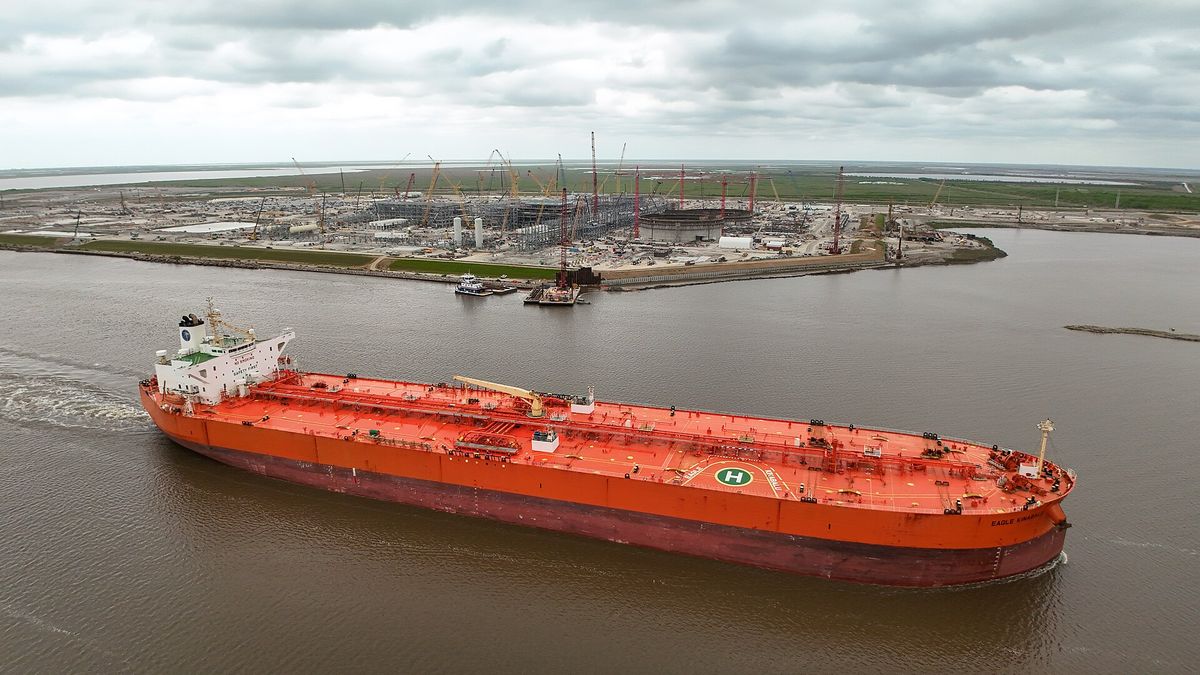
Freight is the constraint. In early October, chartering a supertanker to carry 2 million barrels from the U.S. Gulf to China for November loading cost about $80 million, according to shipbrokers Simpson, Spence & Young, Reuters reported on Oct. 8. That works out to roughly $40 a barrel in shipping alone, against about $8.60 before the war.
Rates on the route have climbed more than 300% since mid-August, said June Goh of Sparta Commodities, who pointed to inefficient ship-to-ship transfers used as a workaround to the Hormuz closure.
Japanese refiner Cosmo Oil provisionally booked a supertanker for $81 million for a U.S. cargo loading Nov. 19 to 21, according to the Reuters report. Offers of $76 million to $77 million from South Korea's SK Energy and trading house Trafigura did not secure ships. Trafigura instead chartered a smaller tanker carrying about 600,000 barrels for $24 million to load U.S. oil for Japan on Nov. 1, a sign that some buyers are splitting cargoes to keep the trade moving.
The alternatives are not cheap either. The premium for the UAE's Murban grade over Dubai benchmarks rebounded to more than $11 a barrel, and traders have also looked at Argentina's Medanito crude.
Prices give U.S. sellers some cushion. Brent's January contract settled at $113.43 a barrel on Oct. 30 after rising 13.6% in October, while West Texas Intermediate settled at $104.12, according to Petroleum Economist. Brent then fell about 3% to near $110 on Nov. 2. The spread between the two benchmarks, about $9 at Friday's close, is what has to cover the higher freight bill. Capital Times reported earlier on the swings in Brent around Saudi-Iran talks.
LNG follows the same route east
The pattern in crude mirrors what has happened in gas. U.S. LNG shipments to Asia more than doubled in the first half of 2026, rising by 2.3 billion cubic feet a day, or 108%, from a year earlier, the EIA said in September. Total U.S. LNG exports averaged 17.4 billion cubic feet a day over the period, up 23%, as Plaquemines LNG ran at full capacity and Golden Pass shipped its first cargo in April. The Japan-Korea Marker reached a four-year high of $15.56 per million British thermal units.
For Japan, which has also been restarting nuclear reactors to cut fuel imports, the heavier reliance on U.S. barrels brings a new exposure: Gulf Coast weather and Pacific freight markets now matter almost as much as Gulf diplomacy.
The next test comes with METI's October import data in late November, which will show whether the Cosmo and Trafigura cargoes, and the November surge Kpler is tracking, lift the U.S. share further.
Sources
- Arab News Japan (METI trade statistics): UAE leads Japan's September oil imports, U.S. ranks second, Saudi third (Oct. 31, 2026)
- Reuters via BOE Report: Asia's crude oil imports back to pre-war levels but refined fuels lag: Russell (Nov. 1, 2026)
- Reuters via BOE Report: Soaring freight rates threaten Asia's appetite for US crude (Oct. 8, 2026)
- Petroleum Economist: The stories that matter: 2 November 2026 (Nov. 2, 2026)
- U.S. Energy Information Administration via Hydrocarbon Processing: U.S. LNG exports rose 23% in the first half of 2026 because of higher capacity (Sept. 1, 2026)
Our standards: Capital Times reports under the principles set out in our Editorial Standards and Ethics Policy. Spotted an error? Report it to our editors.