Chile Cuts 2026 Copper Output Forecast to 8.4% Drop, Raises Price View to $6.18 a Pound
The world's biggest copper producer now sees output falling 8.4% this year after a 15% slump in September, while China takes more than half the world's metal.
What to know
- Cochilco now expects Chile's copper output to fall 8.4% to 4.94 million metric tons in 2026, down from an earlier forecast of a 2.6% decline.
- Chile produced 387,870 tons of copper in September, 15.1% less than a year earlier, according to the National Statistics Institute.
- Cochilco raised its average copper price forecast to $6.18 a pound for 2026 and $5.95 for 2027, and said China will account for 57.3% of world demand.
SANTIAGO
Chile's state copper commission, Cochilco, now expects the country's copper output to fall 8.4% this year to 4.94 million metric tons, a far deeper decline than the 2.6% drop it forecast earlier. In the same quarterly report, released Oct. 30, it raised its forecast for the average copper price to $6.18 a pound for 2026 and $5.95 for 2027.
For Asia, the two numbers point the same way. Chile is the world's largest copper miner, and China, which Cochilco says will keep a 57.3% share of world copper consumption, buys more of the metal than every other market combined. Less Chilean ore means tighter concentrate supply for Asian smelters, and a higher price feeds into costs for cable, grid and electronics makers in the region.
The cut follows a run of weak monthly data. Chile produced 387,870 tons of copper in September, 15.1% less than a year earlier, according to figures from the National Statistics Institute (INE) reported by Reuters. Between January and September, output totaled 3.63 million tons, 8.5% below the same period of 2025, Cochilco said.
Escondida and Codelco drive Chile's copper slump
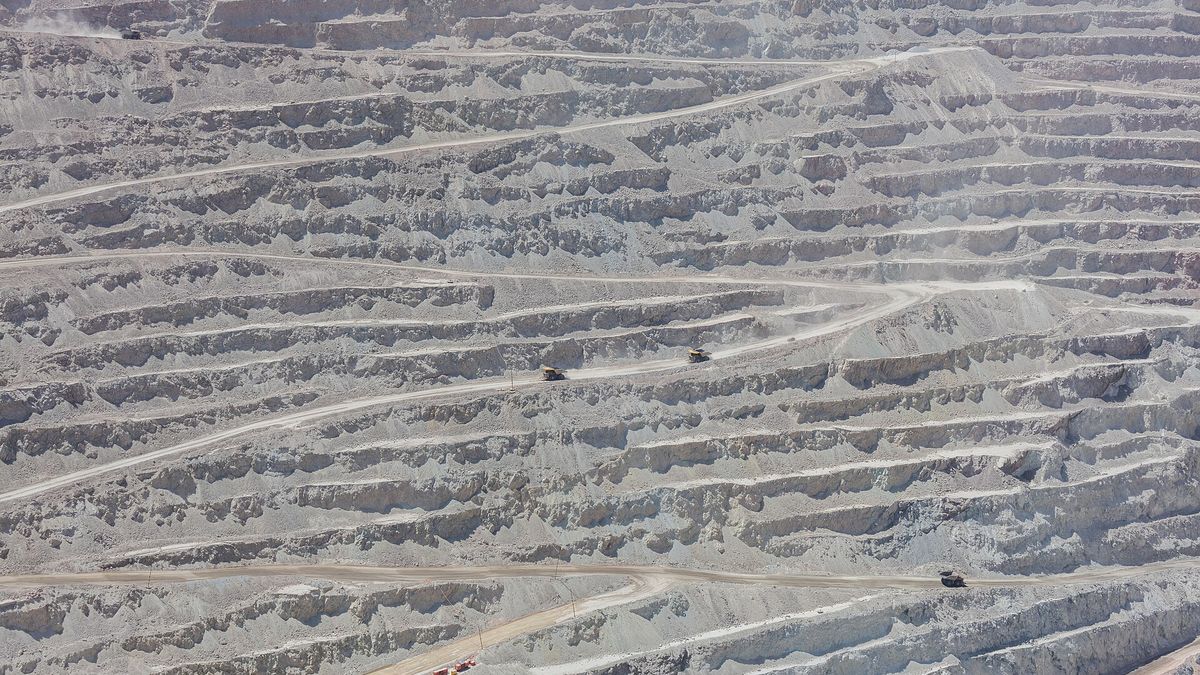
Cochilco said three operations, BHP's Escondida, state-owned Codelco and Spence, together explain 77.3% of the national net decline this year. It blamed lower ore grades, maintenance work and stoppages that have hurt processing and metal recovery.
INE's industrial data showed the scale of the damage to the wider economy. Chile's industrial production index fell 2.7% in September from a year earlier, as metal mining output dropped 12% on lower copper extraction and processing, the agency said. Metal mining alone subtracted about 10.3 percentage points from the mining index, which fell 8.7%. Manufacturing rose 2%, helped by beverages.
INE attributed the mining decline to a temporary suspension at a major company in the sector and to lower ore grades at several deposits, Reporte Minero reported. Reuters, in a report carried by Colombia's La República, said a fatal accident in September forced a temporary halt at Escondida, the world's biggest copper mine, and that Antofagasta Minerals had trimmed its estimates after heavy rain.
The weakness began earlier in the year. August output of 369,500 tons was the lowest monthly figure since February 2011, according to Cochilco data cited by CNN Chile, after storms in July disrupted mines in the country's north.
To hit its new full-year target, Cochilco said Chilean mines would need to average close to 434,000 tons a month in the fourth quarter, 7.6% above the average of the first nine months. September's figure fell well short of that pace.
Copper price forecast rises on thin global surplus
Cochilco's price view rests on a market with little room for error. It expects global mine production to fall 0.6% this year to 23.30 million tons, while refined supply rises 1.1% to 27.64 million tons, supported by intermediate stocks and scrap. With refined demand growing 1.5% to 27.50 million tons, the commission sees a surplus of just 144,000 tons, about 0.5% of world consumption.
Its previous quarterly report had put the average price at $5.95 a pound for 2026 and $5.10 for 2027. Claudia Rodríguez, Cochilco's executive vice president, said the main support for prices is that mine output has been slow to respond to rising demand, and that a recovery in supply is the condition for prices to ease in 2027.
Copper closed the week ended Oct. 30 at $6.55 a pound, up 0.24% on the week, Cochilco said in its weekly market report. The year-to-date average reached $6.15 a pound, 40% above the same period of 2025. The commission said reduced availability of metal in China supported prices, while caution over U.S. interest rates and technology spending limited gains. The Federal Reserve held its policy rate at 3.75% to 4% last week, with two officials voting for an increase, Cochilco noted.
China's copper demand and Asia's mine pipeline
The report also sketched a shift in where demand growth comes from. Cochilco expects China's consumption growth to slow from 1.6% this year to 1% in 2027, although the country would still hold a 57.3% share of world demand. Other markets would grow 2.8% together and supply about two-thirds of the global increase in 2027.
On supply, Cochilco expects world mine output to recover 3.4% in 2027 to 24.08 million tons, with contributions from Chile, the Democratic Republic of Congo, Mongolia, Zambia and Indonesia. Chile and Congo together would account for about 37% of that increase. Chilean output would rise 3% to 5.08 million tons, recovering roughly a third of this year's lost production.
That recovery would leave a refined surplus of 215,000 tons in 2027, about 0.8% of consumption, and supports Cochilco's forecast of a 3.7% fall in the average price between 2026 and 2027. The commission cautioned that the surplus could disappear with operational delays or stronger-than-expected demand, and that a global surplus can coexist with local shortages depending on where inventories sit.
The next test is INE's October mining data. Chile's mines produced about 388,000 tons in September; Cochilco's forecast needs roughly 434,000 tons in each of the last three months.
Sources
- Cochilco (Comisión Chilena del Cobre): Cochilco eleva proyección del precio del cobre a US$5,95 para 2027 (Oct. 30, 2026)
- Cochilco (Comisión Chilena del Cobre): Informe de Tendencias del Mercado del Cobre. Proyecciones 2026 y 2027. Tercer trimestre (Oct. 30, 2026)
- Cochilco (Comisión Chilena del Cobre): Informe del Mercado Internacional del Cobre, semana del 26 al 30 de octubre de 2026 (Oct. 30, 2026)
- Instituto Nacional de Estadísticas (INE): Índice de Producción Industrial disminuyó 2,7% interanualmente en septiembre de 2026 (Oct. 30, 2026)
- La República (Reuters): La producción de cobre en Chile registró una caída de 15,1% en septiembre (Oct. 30, 2026)
- Reporte Minero: Minería arrastra contracción industrial de Chile en septiembre de 2026 (Oct. 30, 2026)
- CNN Chile: Producción de cobre en Chile cae a su nivel más bajo en 15 años en agosto de 2026 (Sept. 30, 2026)
Our standards: Capital Times reports under the principles set out in our Editorial Standards and Ethics Policy. Spotted an error? Report it to our editors.