Inner Mongolia Opens Hohhot Shengle Airport, Retiring 68-Year-Old Baita Overnight
The 4F-class hub is built for 28 million passengers a year and takes every Hohhot flight, as the city bets on routes to Mongolia, Russia and South Korea.
What to know
- Hohhot Shengle International Airport began operations at midnight on Nov. 26, taking over all flights from Baita International Airport, which closed at the same moment, Xinhua reported.
- The new airport is designed to handle 28 million passengers, 320,000 tonnes of cargo and mail, and 244,000 aircraft movements a year, according to the Hohhot city government.
- Baita's international traffic jumped in the first seven months of 2026, with 997 cross-border flights, up 69.9%, and 69,200 cross-border passengers, up 89.3%.
HOHHOT
Hohhot, the capital of China's Inner Mongolia Autonomous Region, switched its entire air service to a new airport overnight on Thursday. Hohhot Shengle International Airport began operations at midnight on Nov. 26 and took over every flight from Hohhot Baita International Airport, which stopped operating at the same moment, Xinhua reported.
The move retires an airport that opened in 1958 and had long outgrown its design. Baita was planned to handle 3 million passengers a year by 2015, according to the Hohhot city government, which said traffic had since run well past that ceiling as the regional economy and tourism grew.
Shengle is built for a much larger market. The Hohhot City Integrated Media Center, the city's official media outlet, said the airport is designed for 28 million passengers, 320,000 tonnes of cargo and mail, and 244,000 aircraft movements a year. China Daily, citing Xinhua, reported last year that those capacity figures are targets for 2030. The passenger figure alone is more than nine times what Baita was originally planned to handle.
A 4F hub on the grassland
Shengle is the first airport in Inner Mongolia rated 4F, the top category under international aerodrome codes, which allows it to receive the largest passenger jets, including the Airbus A380. China Daily reported that mainland China had 16 operating 4F airports as of June 2025. An Air China verification flight in November 2025 checked the runways, taxiway markings and navigation systems, all of which met industry standards, Xinhua reported at the time.
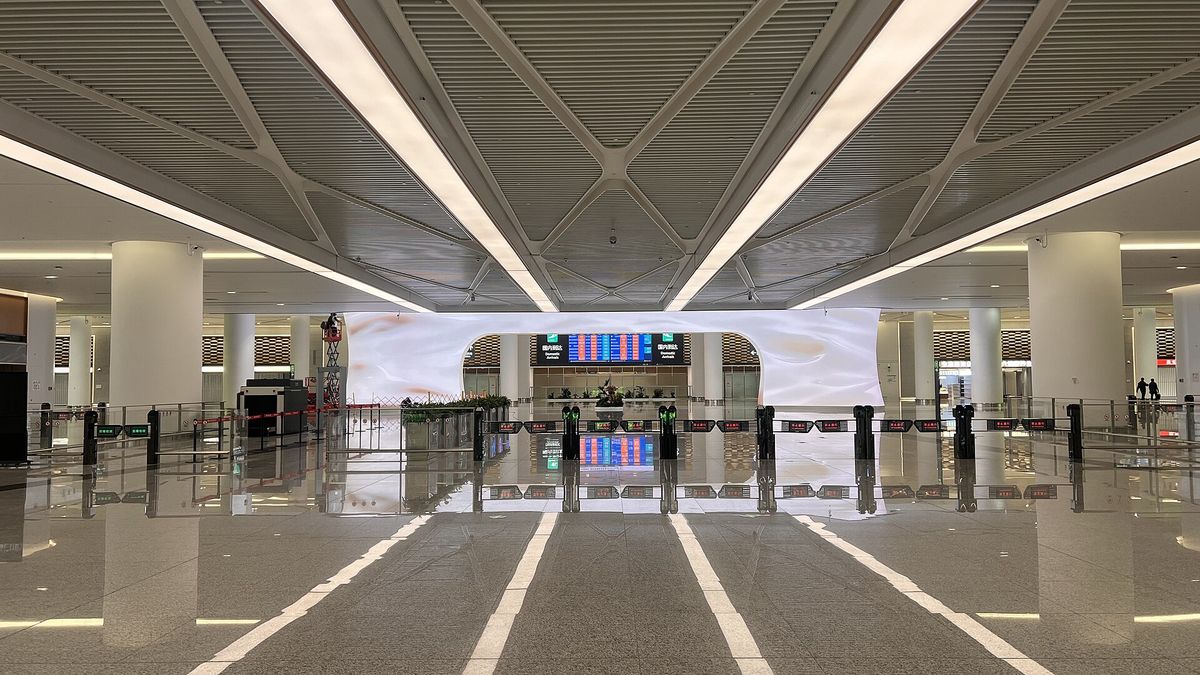
The city government said the terminal covers 320,000 square meters and the apron has 130 aircraft stands. Two parallel runways sit 2,000 meters apart and can be operated independently of each other. The departures hall has separate zones for international flights and for flights to Hong Kong, Macao and Taiwan, with bilingual Chinese and English signs.
Shengle is meant to do more than serve Hohhot's own travelers. The city government describes it as a regional aviation hub, a major alternate airport for the Beijing-Tianjin-Hebei airport cluster, and a national Class I port of entry. Its border inspection facilities passed a regional acceptance check in March.
Betting on cross-border demand
The international business is still small but growing fast. In the first seven months of 2026, Baita handled 997 cross-border flights, up 69.9% from a year earlier, and 69,200 cross-border passengers, up 89.3%, according to the city government.
All six of Baita's scheduled international passenger routes have moved to Shengle: Ulaanbaatar in Mongolia; Seoul, Daegu and Busan in South Korea; Vladivostok in Russia; and Bangkok, via Chongqing. The Korean links tie into a broader rebound in Chinese travel to South Korea, which drew 6.07 million mainland visitors in the first 10 months of the year, as Capital Times reported this week.
City officials said they plan to add international routes to Russia and Mongolia, increase frequencies to the Yangtze River Delta, the Guangdong-Hong Kong-Macao Greater Bay Area and the Chengdu-Chongqing region, and build up regional feeder flights across Inner Mongolia. The release did not say which airlines would add capacity or when.
What to watch
The first test is operational. A midnight switchover of an entire airport's traffic leaves little margin, and the coming weeks of winter weather on the Inner Mongolian plateau will show how well the new systems and ground transport links hold up. Ground access to the new site will also matter for airlines that compete with high-speed rail on short domestic routes, a market where China's trains keep setting ridership records.
The second is commercial. Shengle's design capacity is far larger than anything Baita was built for, and filling it depends on carriers adding seats at a time when many Chinese airlines are still losing money and Beijing is reported to be weighing consolidation among weaker carriers. Investors in the big three state groups, Air China, China Eastern and China Southern, will be watching whether new airports in second-tier cities like Hohhot generate profitable traffic or simply spread existing demand across more expensive infrastructure.
The first full months of traffic figures from Shengle will show whether airlines are adding seats or simply moving their Baita schedules across town.
Sources
- People's Daily Online (Xinhua): First 4F-class airport in China's Inner Mongolia starts operations (Nov. 26, 2026)
- Hohhot City Integrated Media Center via Media OutReach Newswire: A New Grassland Hub Connecting to the World: Hohhot Shengle International Airport Set to Open (Nov. 20, 2026)
- Global Times (Xinhua): Hohhot Shengle International Airport to start operations on Nov. 26 (Nov. 20, 2026)
- Travel Trade Journal: Hohhot Shengle International Airport to begin operations on November 26 (Nov. 21, 2026)
- China Daily (Xinhua): Hohhot's new 4F-class airport completes test flight (Nov. 26, 2025)
Our standards: Capital Times reports under the principles set out in our Editorial Standards and Ethics Policy. Spotted an error? Report it to our editors.