Petronet Presses Qatar to Speed Up Missed LNG as Just 6 of About 80 Cargoes Arrive
India's largest LNG importer says Doha cannot commit to a recovery schedule until Hormuz shipping normalizes, a test for Asian buyers of Qatari gas.
What to know
- Petronet LNG received only about six of the 75 to 80 Qatari cargoes it expected from March to October 2026, Business Standard reported.
- Petronet's 7.5 million-ton-a-year contract with QatarEnergy lets force majeure cargoes be delivered at original prices within a one-year recovery period.
- QatarEnergy expects the first North Field East train to start in the first quarter of 2027, subject to a U.S.-Iran peace deal, Reuters reported.
NEW DELHI
Petronet LNG, India's largest importer of liquefied natural gas, is pressing QatarEnergy to deliver its missed cargoes ahead of schedule after receiving only about six of the 75 to 80 shipments it expected from Qatar between March and October, according to Business Standard.
The shortfall shows how deeply the Strait of Hormuz disruption has cut into supply for Asia's long-term Qatari contract holders. India, China, Japan, South Korea and Malaysia all have multi-decade purchase deals with Doha, and those contracts now carry an open question: when, and at what pace, the lost volumes come back.
Akshay Kumar Singh, Petronet's managing director and chief executive, told reporters after the company's quarterly results on Monday that the importer was in active talks with Qatar on the timing. He said Qatar "cannot commit till then," meaning until conditions return to normal, the newspaper reported.
Petronet's recovery clause and quarterly numbers
Before the war, Petronet typically took nine to 10 Qatari cargoes a month, each carrying about 138,000 cubic meters of LNG, according to Business Standard. Separately, about 53 to 54 cargoes are still owed to it from a 2015-16 settlement with Qatar.
The company's main supply deal, a 20-year agreement for 7.5 million metric tons a year that runs from May 2028 to December 2048, renewed a contract signed in 1999. It includes a one-year recovery period during which deferred cargoes and those hit by force majeure can be delivered at the original long-term price, without renegotiation. Petronet wants them sooner than that window requires.
The pricing clause matters. With Asian spot LNG prices elevated by the Hormuz disruption, deferred cargoes at the old contract price can be cheaper for the buyer than spot replacements. Qatar has not given numbers on how it will schedule make-up volumes across its customers.
Petronet reported results for the quarter ended Sept. 30 on Monday. Consolidated net profit rose 54% from a year earlier to 12.35 billion rupees, while revenue from operations fell 34.5% to 72.02 billion rupees, Business Standard reported. Its Dahej terminal in Gujarat ran at 73% of capacity, down from 92%, and company-wide utilization slipped to 64% from 78%. The board declared an interim dividend of 7 rupees a share.
Qatar's force majeure and the North Field East delay
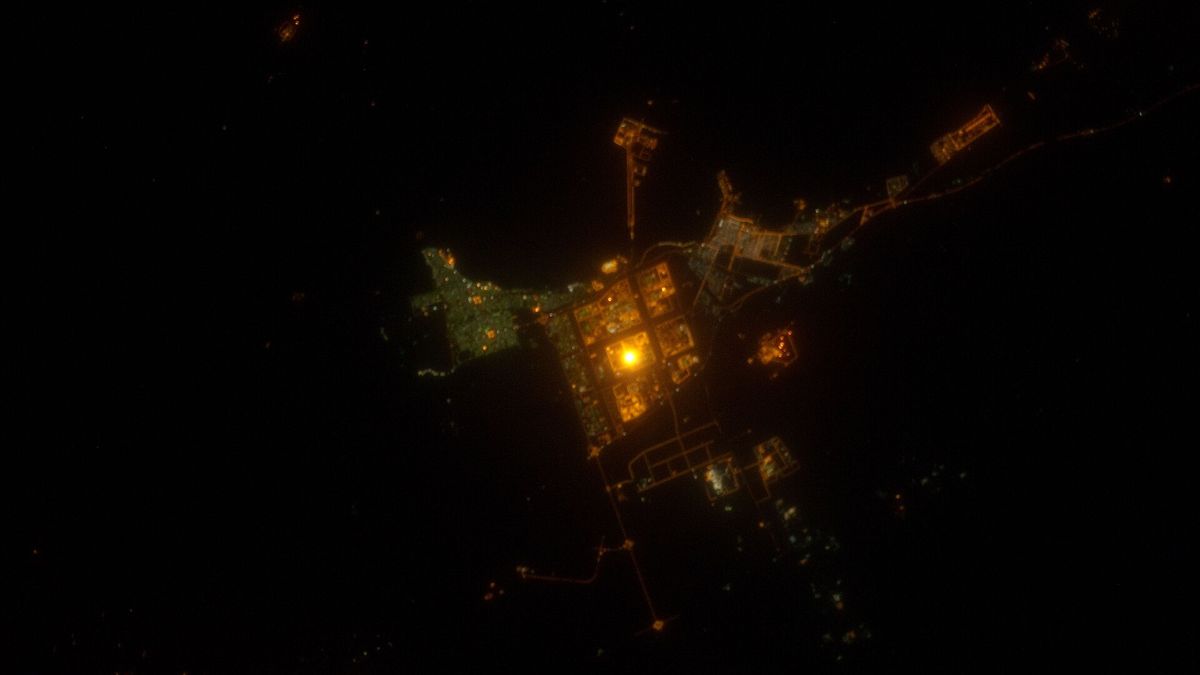
QatarEnergy halted production in early March after Iranian missile strikes and declared force majeure on March 4, a notice that now runs to the end of 2026, Reuters reported on Oct. 29. Qatar supplies about a fifth of global LNG exports, all of it shipped through Hormuz.
Two of the 14 liquefaction trains at Ras Laffan were damaged, taking out 12.8 million tons a year, or about 17% of export capacity. Repairs will take about three years. Saad Al Kaabi, Qatar's minister of state for energy affairs and QatarEnergy's chief executive, has said production could restart within a week of a peace deal if ships are available, but output would be capped at about 83% of pre-war levels until the damaged units return, according to Reuters.
Those two trains serve customers in China and South Korea as well as Belgium and Italy, Natural Gas Intelligence reported in March. In that article, Al Kaabi warned that QatarEnergy would be forced to declare force majeure on some long-term contracts for as long as five years.
The expansion that was meant to make Qatar the dominant source of new supply this decade has also slipped. Al Kaabi now expects the first train of the North Field East project to start in the first quarter of 2027, with production dependent on a U.S.-Iran peace deal, Reuters reported. The North Field East, South and West projects are intended to lift capacity at Ras Laffan from 77 million tons a year to 142 million tons. He said the plan is unchanged.
Much of that new capacity is already sold to Asia. Sinopec signed a 27-year deal for 4 million tons a year from North Field East in November 2022. In February, at the LNG2026 conference in Doha, QatarEnergy signed a 27-year agreement with Japan's JERA for up to 3 million tons a year and a 20-year deal with Malaysia's Petronas for 2 million tons a year, both with deliveries starting in 2028.
What buyers are watching
QatarEnergy has been buying U.S. supply instead: deals for up to 4 million tons a year from Cheniere Energy and 3 million tons a year from Woodside's U.S. operations, plus talks with Venture Global, Reuters reported. Those volumes do not directly help contract holders like Petronet. Long-term contracts are point-to-point, tying deliveries to specific export terminals and destinations, so U.S. volumes cannot serve as backup for Hormuz disruptions, Al Kaabi said.
For Indian importers, the immediate issue is volume through the winter. Petronet's utilization figures show how much spare regasification capacity it now has, and Business Standard reported that both sides are monitoring shipping conditions in the strait before setting any delivery plan.
QatarEnergy's force majeure is due to expire on Dec. 31. Any extension of that notice, and any change to the first-quarter start date for North Field East, will set the schedule for Petronet's 53 to 54 settlement cargoes and the months of shipments it has missed since March.
Sources
- Business Standard: Petronet LNG seeks early delivery of Qatar cargoes amid Hormuz disruptions (Nov. 2, 2026)
- gCaptain (Reuters): QatarEnergy Continues LNG Buying Spree to Hedge Future Hormuz Disruptions (Oct. 29, 2026)
- Natural Gas Intelligence: North Field Expansion Project Delays Likely as Qatari LNG Output Crippled by Iranian Attacks (March 20, 2026)
- Arabian Business: QatarEnergy signs 27-year supply deal with JERA to deliver LNG to Japan (Feb. 3, 2026)
- Gulf Times: QatarEnergy, Petronas sign 20-year agreement to supply Malaysia with LNG (Feb. 4, 2026)
- Euro Petrole: QatarEnergy and Sinopec sign a 27-year 4 million tons per annum LNG supply agreement to China (Nov. 21, 2022)
Our standards: Capital Times reports under the principles set out in our Editorial Standards and Ethics Policy. Spotted an error? Report it to our editors.