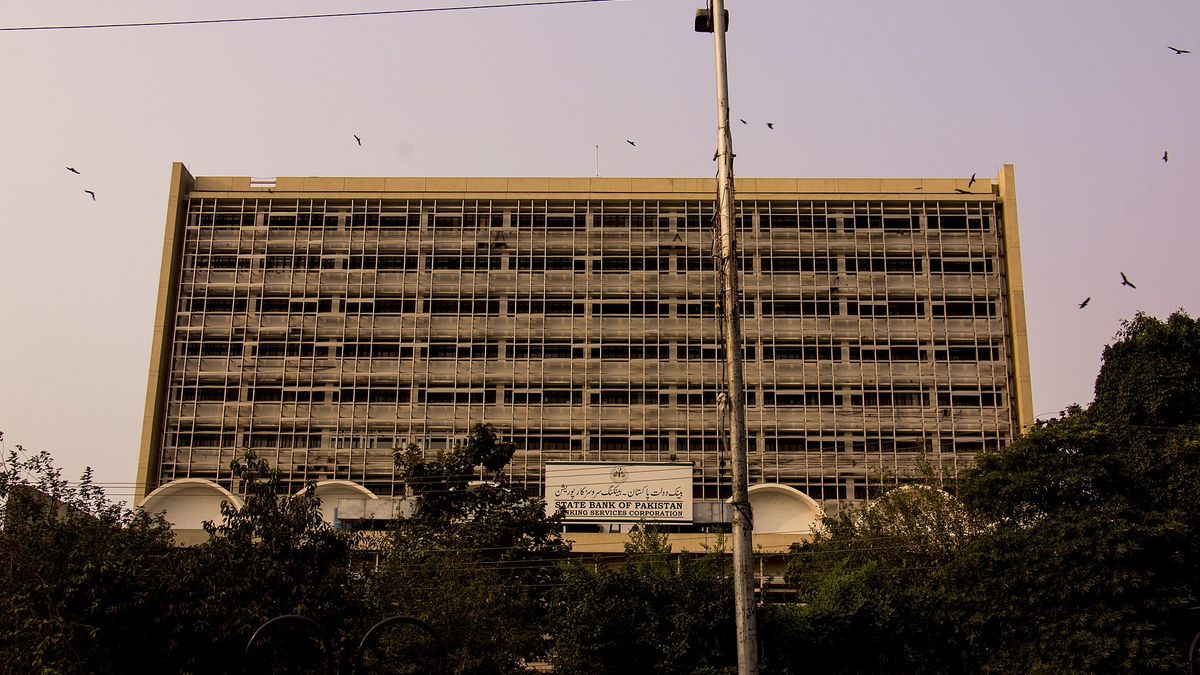
State Bank of Pakistan Keeps 3.5% to 4.5% Growth Forecast as Energy Shock Lifts Prices
The central bank's annual report sees reserves climbing toward four months of imports, while newspapers differ on how close it expects inflation to come to its 5% to 7% target.
What to know
- The State Bank of Pakistan kept its forecast for real GDP growth in fiscal 2027 at 3.5% to 4.5% in its FY26 annual report released on Nov. 16.
- The central bank projected average inflation of 5.5% to 7.5% this fiscal year, above its 5% to 7% target, after 7.1% in fiscal 2026, The News reported.
- It expects the current account deficit to stay within 0% to 1% of GDP and reserves to rise toward four months of import cover, helped by a $3 billion Eurobond.
KARACHI
The State Bank of Pakistan held its forecast for economic growth in the fiscal year to June 2027 at 3.5% to 4.5% on Monday, but said in its annual report that the global energy price shock would put upward pressure on inflation this year. The News reported that the bank expects inflation to stay above its 5% to 7% medium-term target, while Dawn reported that it expects a gradual easing toward that range.
The report on the state of the economy in fiscal 2026 is the central bank's first broad assessment since it raised its policy rate to 12% on Oct. 26. For investors in Pakistani bonds and equities, it sets out how far the bank thinks the economy can absorb higher oil prices without a balance-of-payments squeeze, a question that has dogged the country in past energy shocks.
Growth holds, but the risks pile up
The bank said the economy entered fiscal 2027 on firmer footing than it did during the 2022 shock that followed Russia's invasion of Ukraine, The News reported. It credited continued engagement with the International Monetary Fund, larger fiscal and external buffers and recent sovereign credit rating upgrades. Dawn reported that growth in fiscal 2026 rose mainly on a rebound in large-scale manufacturing.
The 3.5% to 4.5% range matches what the bank gave in its July, September and October monetary policy statements, according to The News. The paper noted that the IMF projected 3.5% growth for fiscal 2027 last month and the World Bank 3.8%.
In the report, the bank said it expects momentum to carry into the current year, supported by "the lagged impact of earlier monetary easing," along with a recovery in domestic demand and fiscal measures aimed at industry, as quoted by The News.
The list of threats is long. The bank flagged a drawn-out Middle East conflict, which could disrupt supply chains and raise input costs, and weaker economic conditions in the Gulf, the source of much of Pakistan's remittance income. It also named El Nino damage to crops and the effect of the India-EU free trade agreement on Pakistani exports, The News reported. Dawn said preliminary data still showed higher output of sugarcane, rice and maize than a year earlier.
Two readings of the inflation outlook
Inflation is where the outlook has shifted most. Dawn reported that average consumer inflation in fiscal 2026 stayed near the top of the target range, even though the energy shock pushed year-on-year inflation into double digits from April 2026. The News put the fiscal 2026 average at 7.1%.
For the current year, the bank projected average inflation of 5.5% to 7.5%, according to The News, which quoted the report as saying it expects inflation "to remain above the medium-term target range in FY27." Dawn described the bank as expecting a gradual easing toward the range, with the energy shock adding upward pressure along the way. The two framings can both be drawn from the projection reported by The News, since a 5.5% to 7.5% range sits partly inside and partly above the 5% to 7% target.
Monthly figures cited by The News show headline inflation of 9.6% in October, down from 10.3% in September and 11.1% in August. The bank warned that rising input costs could make core inflation stickier, though it said a prudent monetary stance should keep expectations anchored.
The report also pointed to changes in fuel pricing. The government moved petroleum price reviews from every two weeks to weekly in March and to daily adjustments from July, which the bank said should pass changes in world oil prices through more smoothly instead of in large jumps, The News reported. Wheat imports have been allowed to ease food supply strains.
Reserves, the current account and the IMF
On the external side, both papers reported that the bank expects the current account deficit to stay within 0% to 1% of GDP in fiscal 2027, after a deficit of 0.1% of GDP in fiscal 2026, according to Dawn. Imports should rise with stronger activity, tariff cuts and higher commodity prices, while exports recover moderately and remittances keep growing.
Reserves are expected to climb toward four months of import cover. The bank cited its own purchases of dollars in the interbank market, expected official inflows and a $3 billion Eurobond sold in September. In fiscal 2026, Dawn reported, reserves were helped by those purchases, a reduction in forward liabilities and steady official inflows.
The IMF program remains the anchor. Fund staff reached a staff-level agreement with Pakistan on Oct. 7 on the fourth review of its Extended Fund Facility and the third review of its climate-focused Resilience and Sustainability Facility, worth about $1.21 billion in total and subject to approval by the IMF Executive Board, Gulf News reported at the time. Among the conditions it listed: the State Bank should keep policy tight until inflation returns durably to target, and the exchange rate should stay flexible. Gross reserves had risen to about $21.5 billion by the end of September, the paper said.
On public finances, the central bank projected a fiscal deficit of 3% to 4% of GDP this year, and said fiscal consolidation and power sector reforms should keep spending in check while better tax enforcement supports revenue. Dawn reported that the report also carried a chapter on structural barriers to job creation, citing weak and volatile growth, premature deindustrialization, low female labor force participation and high youth unemployment.
The bank's policy rate stands at 12% after two increases this year, against October inflation of 9.6%. The report gives its next markers: reserves moving toward four months of import cover, a current account deficit capped at 1% of GDP and average inflation of 5.5% to 7.5% in the year to June 2027.
Sources
- Dawn: SBP says inflation to ease to 5-7pc target range during FY2027 (Nov. 16, 2026)
- The News International: SBP holds FY27 growth forecast at 3.5-4.5pc (Nov. 17, 2026)
- Gulf News: What IMF's $1.2b funding means for Pakistan? (Oct. 8, 2026)
Our standards: Capital Times reports under the principles set out in our Editorial Standards and Ethics Policy. Spotted an error? Report it to our editors.