India's Fiscal Deficit Hits 42.1% of FY27 Target in First Half as Fuel Tax Cut Bites
Excise receipts fell 22% after a cut in fuel duties and capital spending slowed in the second quarter, and ICRA expects a modest miss on the 4.3% goal.
What to know
- India's central government fiscal deficit was INR 7.14 trillion in April through September, or 42.1% of the full-year target, against 36.5% a year earlier.
- Union excise duty collections fell 22% to 1.08 trillion rupees after the government cut fuel duties in late March, Business Standard reported.
- ICRA's chief economist expects a slippage of 1.3 trillion to 1.4 trillion rupees against the FY27 deficit goal of 4.3% of GDP, which spending savings could partly absorb.
NEW DELHI
India's central government ran a fiscal deficit of INR 7.14 trillion in the first half of the fiscal year, using up 42.1% of its full-year target, as a cut in fuel duties held back revenue while subsidy and infrastructure spending climbed.
The figure, published by the Controller General of Accounts on Oct. 30, compares with 36.5% of the target at the same point a year earlier, when the April-September gap was about 5.7 trillion rupees. That is an increase of roughly a quarter. For investors in Indian government bonds and the rupee, the data sharpen a question that has hung over the market since New Delhi lowered fuel taxes in March as crude prices rose: whether the government can hold the deficit to 4.3% of gross domestic product for the year ending March 2027 without borrowing more.
The government has budgeted a full-year deficit of 16.96 trillion rupees. The ratio barely moved in September itself. At the end of August the deficit stood at 7.10 trillion rupees, or 41.9% of the target, according to the CGA's August accounts. Comparing the two CGA totals, Capital Times calculates that the gap widened by only about 42 billion rupees during September.
India's tax revenue slows after the fuel duty cut
Total receipts rose about 6% from a year earlier to 18.35 trillion rupees, or 50.3% of the budget estimate, CGA data showed. That pace is close to last year's 49.5%. The weakness sits in revenue receipts, which grew just 3.6%, according to Aditi Nayar, chief economist at ICRA, as quoted by Business Standard.
Net tax revenue, the amount the center keeps after sharing with the states, was 12.76 trillion rupees, up from 12.3 trillion rupees and equal to 44.5% of the annual estimate. Gross tax collections rose 6% to 19.80 trillion rupees, Business Standard reported.
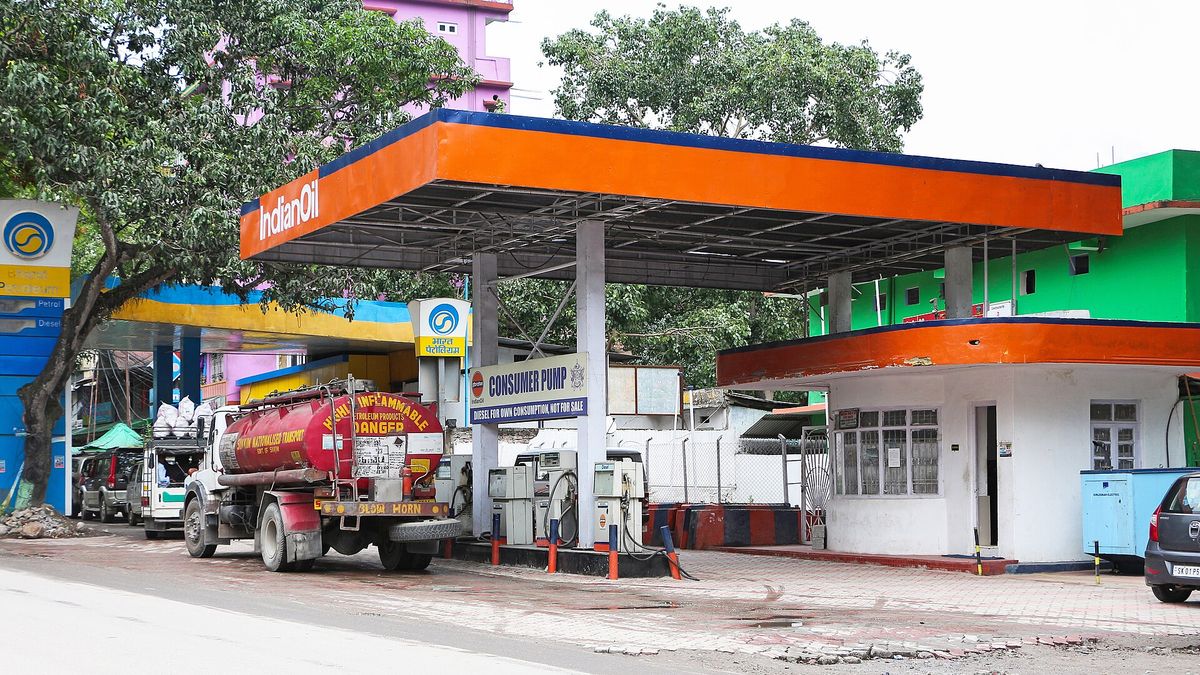
The sharpest drag came from Union excise duty, which fell 22% to 1.08 trillion rupees. The government cut the special additional excise duty on petrol and diesel by 10 rupees a liter in late March as crude prices rose after war broke out in West Asia, the newspaper said. Income tax collections grew about 7% to 6.31 trillion rupees, while customs duty rose nearly 17%.
Nayar said the second-half growth needed to hit the excise and income tax targets, between 28% and 38%, makes a miss on both likely, although extra customs revenue would partly offset it. Non-tax revenue reached 4.81 trillion rupees, or 72.2% of the budget, behind the 79.9% pace of a year earlier.
Subsidies climb while capital spending loses pace
Total spending rose 10.7% to 25.5 trillion rupees, according to Trading Economics, or 47.7% of the full-year plan. Revenue expenditure, which includes subsidies and interest, rose about 10% to 18.95 trillion rupees. Interest payments alone were 6.46 trillion rupees, 46% of the 14.04 trillion rupees budgeted, slightly ahead of last year's 45.3% pace.
Food and fertilizer support drove the subsidy bill. Food subsidies rose to 1.03 trillion rupees from 884 billion rupees a year earlier, and the center had spent 855.9 billion rupees on urea, 73% of the annual allocation, and 336.6 billion rupees on nutrient-based fertilizers, or 62%, the CGA tables show. Major subsidies totaled 2.23 trillion rupees, 54% of budget. The petroleum subsidy line was small by comparison: 11.5 billion rupees, against 67.2 billion rupees a year earlier.
As a result, the revenue deficit, the gap between revenue spending and revenue receipts, reached 1.38 trillion rupees, or 23.4% of the annual target. A year earlier it stood at 5.2%.
Capital expenditure on infrastructure and other assets rose 12.7% to 6.55 trillion rupees, reaching 53.6% of the budget. The monthly trend has turned, however. Capital spending fell 3% from a year earlier in September after a 30% drop in August, according to Nayar, as reported by The Hindu BusinessLine, cutting growth to 2.8% in the July-September quarter from 23.7% in the first quarter. She said the slowdown may weigh on GDP growth. The second half now needs 16.2% growth to meet the capex budget.
Economists see a modest miss on India's 4.3% deficit goal
Economists cited by Business Standard said the government may struggle to meet the 4.3% target. ICRA expects fertilizer and fuel subsidies to overshoot and receipts to fall short while global energy prices stay high, leading to a slippage of 1.3 trillion to 1.4 trillion rupees against the target, Nayar said, according to BusinessLine. Spending savings, which reached 1.6 trillion to 1.7 trillion rupees in fiscal 2025-26, could absorb part of it.
The borrowing picture matters for bond markets. Nayar said “a fiscal slippage may not necessarily manifest into higher borrowings,” because small savings inflows rose 54% in the first half and are set to beat the budget. CGA financing tables show the government raised a net 5.38 trillion rupees through market borrowings by September, 41% of the annual plan, against a 33% pace a year earlier.
The banking system's cash surplus has already shrunk as the Reserve Bank of India sells dollars to defend the rupee, which costly oil has kept under pressure.
The CGA cautions that monthly deficit figures are distorted by timing gaps between receipts and spending, which can be largely offset by the end of the fiscal year. The next test comes on Nov. 30, when the accounts for April through October are due, according to the Trading Economics release calendar.
Sources
- Controller General of Accounts, Ministry of Finance: Union Government Accounts at a Glance as at the End of September 2026 (Oct. 30, 2026)
- Controller General of Accounts, Ministry of Finance: Union Government Accounts at a Glance as at the End of August 2026 (Sept. 30, 2026)
- Business Standard: India's fiscal deficit reaches 42.1% of FY27 target in April-September (Oct. 30, 2026)
- Business Standard: Centre's fiscal deficit widens to 42% of FY27 target in H1: CGA data (Oct. 30, 2026)
- The Hindu BusinessLine: Capex grows 12% in April-September; fiscal deficit rises around 25% (Oct. 30, 2026)
- The Economic Times: India's fiscal deficit for April-September at Rs 7.14 lakh crore, widens to 42.1% of FY27 aim (Oct. 30, 2026)
- Trading Economics: India Central Government Budget Value (Oct. 30, 2026)
- Free Press Journal: India's Fiscal Deficit Hits ₹7.1 Lakh Crore In April-August, Reaches Nearly 42% Of FY27 Target (Sept. 30, 2026)
Our standards: Capital Times reports under the principles set out in our Editorial Standards and Ethics Policy. Spotted an error? Report it to our editors.