Lai Fung Plans Shanghai REIT for Hong Kong Plaza to Repay HK$2.47 Billion Loan Due March
The Lai Sun group says a listing on China's new commercial REIT market is its only workable way to raise cash, as rents at the Huaihai Road complex fall.
What to know
- Lai Fung Holdings plans to put the mall and office tower of Shanghai Hong Kong Plaza into a commercial REIT listed on the Shanghai Stock Exchange, a Nov. 17 filing showed.
- The group said the listing is its only commercially feasible way to repay offshore syndicated loans of HK$2,467 million due in March 2027, which are secured on the plaza.
- Rental revenue at the plaza fell 10.5% to 207.8 million yuan in the year to July 31, while Lai Fung's net loss widened to HK$591.6 million.
HONG KONG
Lai Fung Holdings plans to spin off the shopping mall and office tower of Shanghai Hong Kong Plaza into a real estate investment trust listed in Shanghai, using the proceeds to repay HK$2.47 billion of loans that fall due in March 2027.
The plan was set out in a joint filing by Lai Fung, its parent Lai Sun Development and the top holding company Lai Sun Garment (International) on Tuesday, Nov. 17. The Hong Kong stock exchange has confirmed the spin-off may proceed, but the application has not yet gone to the China Securities Regulatory Commission or the Shanghai Stock Exchange, the companies said. They gave no fundraising target.
For investors, the filing is an unusually blunt account of how hard it has become to sell or refinance a large commercial building in mainland China. It also shows Hong Kong developers with debts to meet turning to mainland China's commercial REIT market, which listed its first trusts in June. Capital Times has also reported on Shanghai office vacancy.
A listing as the only option
The loan in question is a set of offshore syndicated facilities totaling HK$2,467 million (about US$315 million, according to Mingtiandi), secured among other things by a mortgage over the plaza. Lai Fung said it expects the REIT proceeds to be enough to repay it in full. If they fall short, the spin-off would go ahead only if the rest can be covered from internal cash or other financing.
The filing lists the alternatives the group ruled out. A direct sale of the whole plaza before the loan matures has "very limited prospect" because of weak demand for en bloc commercial property in China, it said. Long-term refinancing of the full amount on acceptable terms is not commercially feasible, because Lai Fung has no operations or material assets outside the mainland. A share sale is impractical given the stock's low price and thin trading. Lai Sun Development and Lai Sun Garment said they are not in a position to keep supplying enough cash on top of existing intercompany loans.
The stakes of a default are spelled out in a footnote. If the mortgage were enforced, Lai Fung would likely have to sell the plaza at a significant discount, and missed payments would trigger acceleration of other group loans.
There is also a land-tenure reason. The plaza's land is held for 50 years from September 1992, so the term ends in 2042, Lai Fung's annual report shows. According to the filing, a REIT offering gives access to streamlined renewal procedures and allows offering proceeds to be used to pay renewal costs, benefits that a private sale would not get.
Falling rents at a Huaihai Road landmark
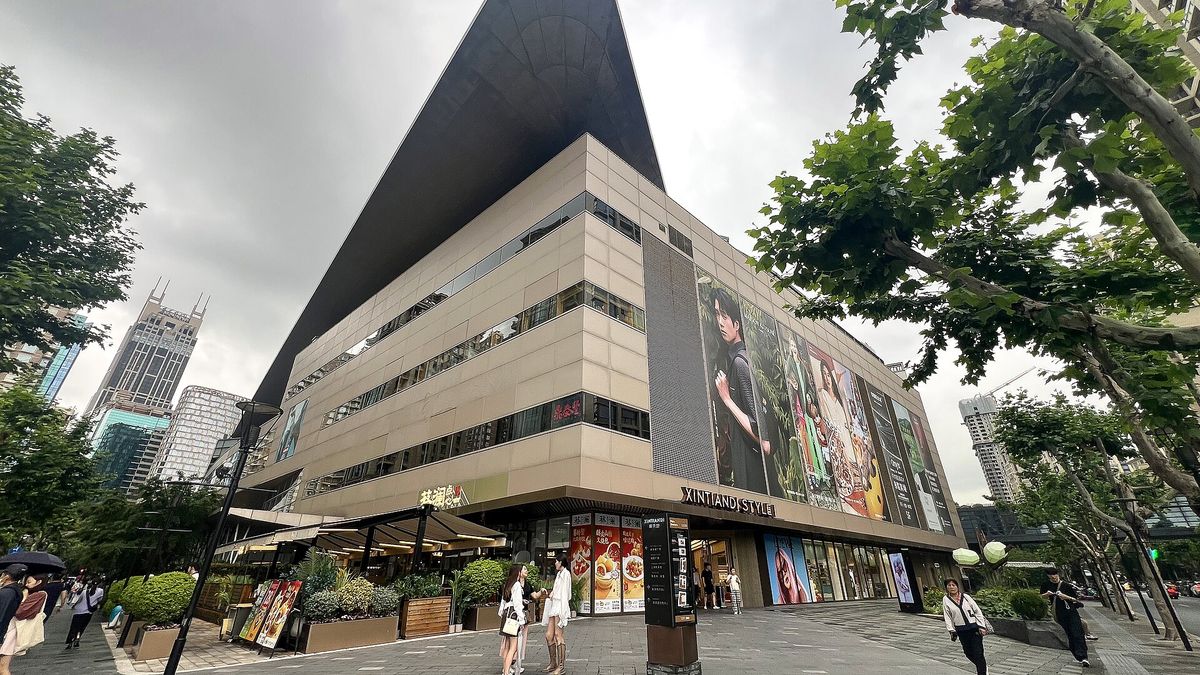
Shanghai Hong Kong Plaza sits above Huangpi South Road metro station on Huaihai Middle Road, within walking distance of Xintiandi. The REIT would hold its 32-story office building and mall, with about 362,100 and 468,400 square feet of floor area respectively. The serviced apartment tower run by Ascott stays outside the trust. Anchor tenants include the Apple Store, Massimo Dutti, Genesis Motor and Swarovski, according to the annual report.
Occupancy has held up even as rents have not. At the end of July the mall was 96.2% let and the offices 88.3%, both higher than a year earlier, Lai Fung's annual report for the year to July 31 shows. But rental revenue from the plaza fell 10.5% to 207.8 million yuan. In its outlook, the company said Shanghai and Guangzhou still face high office vacancy and expects the downward cycle in rents to continue.
The wider group is under strain. Lai Fung's net loss attributable to shareholders widened to HK$591.6 million from HK$419.4 million, and net debt to equity rose to 71.9%. Its shares closed at HK$0.72 on July 31, a 98.1% discount to net asset value per share of HK$37.74, the filing said.
Lai Fung, directly or through a subsidiary, will subscribe for at least 20% of the REIT's units. Under mainland rules, that 20% stake must be held for at least 60 months after listing. Existing Lai Fung shareholders will not get an assured allocation, because only qualified investors may buy units in mainland REITs. The Hong Kong exchange granted waivers on both points.
The C-REIT exit route
The plan follows a similar move on the same stretch of Huaihai Road. New World Development is seeking to sell its K11 Art Mall and K11 Atelier office complex at 300 Huaihai Middle Road into a Shanghai-listed REIT, with the complex valued at about 4 billion yuan, according to Mingtiandi. Its application was accepted by the exchange in September, and the bourse raised follow-up questions in October, Mingtiandi reported on Wednesday.
China's commercial REIT pilot is still young. The first four such trusts listed on the Shanghai Stock Exchange on June 18, raising about 20.3 billion yuan combined from retail and office assets in cities including Beijing, Shanghai and Xi'an, the exchange said at the time. It said 21 projects had been accepted across the market by then.
The next step for Lai Fung is the formal submission to the CSRC and the Shanghai exchange, which the companies have said they will announce. The deal is expected to count as a very substantial disposal for all three listed companies, which brings further announcements and approval steps under Chapter 14 of the Hong Kong listing rules. The loan comes due in March.
Sources
- Lai Sun Garment, Lai Sun Development and Lai Fung Holdings (HKEX filing): Joint Announcement: Possible Spin-Off and Separate Listing of the REIT on the Shanghai Stock Exchange (Nov. 17, 2026)
- Lai Fung Holdings (HKEX filing): Lai Fung Holdings Annual Report 2025-2026 (Nov. 18, 2026)
- Mingtiandi: Lai Sun Plans REIT Spin-Off for Shanghai Complex to Help Repay $315M Loan (Nov. 18, 2026)
- Mingtiandi: New World Aims to Sell Shanghai Tower to REIT for $599M After Land Lease Extended (Sept. 21, 2026)
- Shanghai Stock Exchange: First Batch of Commercial Real Estate REITs Listed on the Shanghai Stock Exchange (June 24, 2026)
Our standards: Capital Times reports under the principles set out in our Editorial Standards and Ethics Policy. Spotted an error? Report it to our editors.