Moutai Profit Rises 3.8% in Third Quarter as i-Moutai App Sales More Than Quadruple
Price increases and direct sales offset a 21.6% drop in nine-month revenue through distributors, while rivals Luzhou Laojiao and Shanxi Fenjiu reported steep declines.
What to know
- Kweichow Moutai's third-quarter net profit rose 3.78% to 19.95 billion yuan on operating revenue up 3.08% to 40.27 billion yuan.
- Sales through the i-Moutai app reached 58.56 billion yuan before tax in the first nine months, up from 12.69 billion yuan a year earlier.
- Luzhou Laojiao's nine-month revenue fell 36.58% and Shanxi Fenjiu's fell 13.8%, while Wuliangye's rose 7.25%.
SHANGHAI
Kweichow Moutai's profit grew again in the third quarter, rising 3.78% from a year earlier to 19.95 billion yuan, as two price increases and a surge in sales through its own i-Moutai app more than made up for a sharp drop in what it sells through distributors.
Operating revenue at China's largest baijiu maker rose 3.08% to 40.27 billion yuan in the three months to Sept. 30, according to the quarterly report it released on the evening of Oct. 30, after the Shanghai market closed. Several brokerages had expected profit to fall by a low single-digit percentage, China Fund News reported, and the growth reversed a second quarter in which both revenue and profit declined.
The results give investors across Asia a fresh read on Chinese demand for premium goods. Hong Kong Securities Clearing, which holds shares on behalf of investors using the Stock Connect trading link, held 4.42% of the company at the end of September, making it the third-largest shareholder, the filing showed.
For the first nine months, operating revenue rose 1.96% to 130.97 billion yuan and profit attributable to shareholders slipped 0.25% to 64.47 billion yuan. The board approved the report on Oct. 29.
i-Moutai app overtakes distributors
The quarter confirmed how quickly Moutai is moving sales away from its distributor network. Revenue from direct sales rose 32.8% to 73.77 billion yuan in the January-September period, while revenue from wholesale and agency channels fell 21.6% to 57.12 billion yuan, according to Capital Times calculations based on the company's operating data for this year and last.
The i-Moutai app did most of the work. It generated 58.56 billion yuan of liquor sales, excluding tax, in the nine months, up from 12.69 billion yuan a year earlier, or about 4.6 times as much. That is about 45% of Moutai's main business revenue, by Capital Times calculation. China Fund News said the jump followed the company's decision to sell its flagship Feitian bottle on the app on a regular basis from Jan. 1.
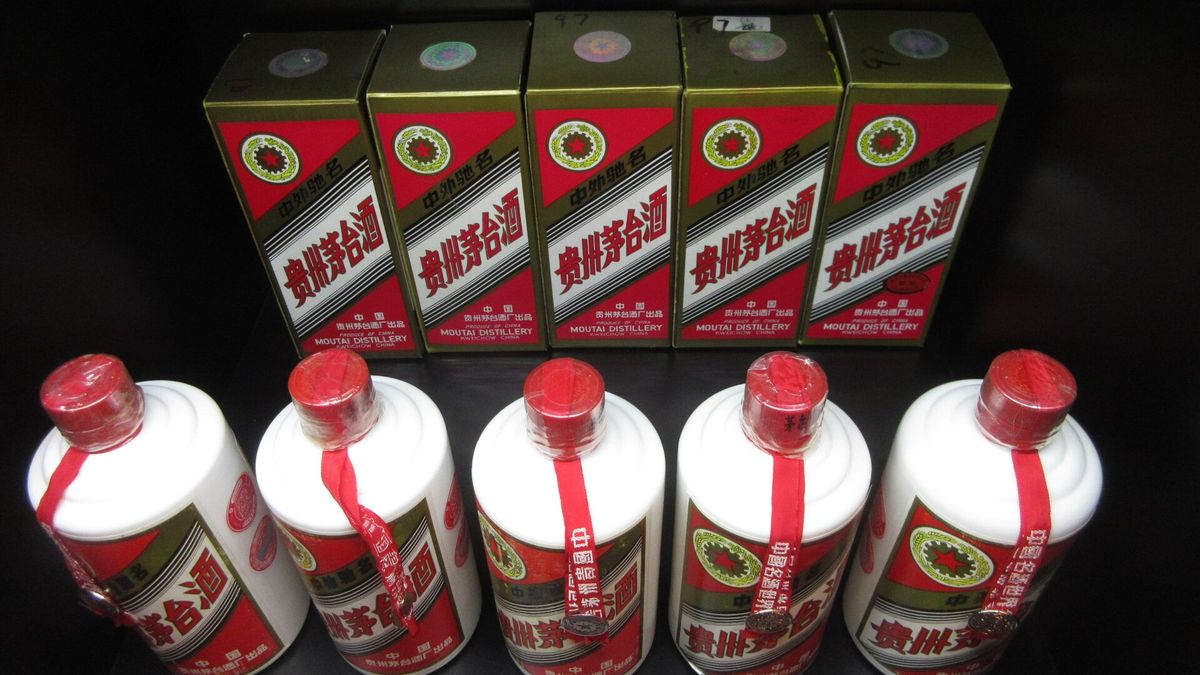
Prices did the rest. On March 31 the company raised the ex-factory price of a 500-milliliter bottle of 53% alcohol Feitian to 1,269 yuan from 1,169 yuan and its own retail price to 1,539 yuan from 1,499 yuan, China Fund News reported. On July 18 it lifted the app price to 1,639 yuan and its sales contract price to 1,369 yuan, a second increase that fell entirely inside the third quarter.
By product, revenue from Moutai liquor, the flagship brand, rose 2.18% to 112.93 billion yuan in nine months, and its cheaper series liquor brands edged up 0.5% to 17.97 billion yuan, according to calculations based on company filings. In the third quarter alone, Moutai liquor revenue grew 0.79% to 35.20 billion yuan, according to calculations by Sina Finance's liquor industry desk.
Overseas revenue fell 58% to 1.64 billion yuan, by the same calculation. Liquor industry commentator Xiao Zhuqing told China Fund News that tighter control of overseas distributors, aimed at stopping bottles flowing back into China, had helped steady domestic prices. Moutai ended September with 2,285 domestic distributors after adding 220 and dropping 288 this year, mostly among series liquor sellers.
Contract liabilities, which largely reflect payments received before goods are delivered, fell to 2.08 billion yuan at the end of September from 8.01 billion yuan at the end of 2025.
Wuliangye, Luzhou Laojiao and Fenjiu lose ground
Moutai's rivals had a much weaker quarter. Wuliangye's third-quarter revenue fell 37.68% to 4.44 billion yuan and its profit dropped 48.25% to 957.7 million yuan, which the company blamed on weak demand and lower sales volumes. Its nine-month revenue still rose 7.25% to 32.86 billion yuan, against 30.64 billion yuan for the same period last year, according to its filing. Nine-month profit jumped 49.98%, which it attributed to a low profit base last year and strong sales of core products over the New Year and Lunar New Year holidays.
Luzhou Laojiao's quarterly revenue fell 37.14% to 4.20 billion yuan and its profit sank 57.03% to 1.33 billion yuan. Its nine-month revenue fell 36.58%, which it attributed to lower sales volumes. Shanxi Fenjiu's quarterly revenue fell 18.11% to 7.34 billion yuan, with profit down 34.52% to 1.90 billion yuan, leaving nine-month revenue 13.8% lower.
Across all 19 listed baijiu makers, nine-month revenue fell 7.61% to 267.82 billion yuan and profit fell 9.6%, according to Wind data cited by Henan financial news outlet Dahe Caijing Lifang in a report carried by Eastmoney. Only four of the 19, including Moutai and Wuliangye, increased revenue, and the group's inventories grew. Moutai alone accounted for almost half the listed group's revenue and two-thirds of its profit.
Shelf prices remain soft. The average retail price of Feitian Moutai rose 3 yuan to 1,787 yuan on Oct. 31, but a basket of 12 leading baijiu products fell for a fourth day to its lowest since mid-September, according to Sina Finance's price tracker, which draws on about 200 collection points. Luzhou Laojiao's Guojiao 1573 slipped to 875 yuan, matching its lowest level in 30 days.
Shares rallied before the numbers
Investors had already moved back into the sector. Moutai's Shanghai-listed shares rose 2.81% to 1,392.05 yuan on Oct. 30, giving it a market value of about 1.74 trillion yuan, China Fund News reported. Luzhou Laojiao and Gujing Gongjiu rose by the daily limit that day as China's main stock indexes fell, Dahe Caijing Lifang reported.
Wind data showed the baijiu index gained 4% in October, while the Shanghai Composite fell 6.33% and the ChiNext index of growth companies lost 23.02%. Yang Delong, chief economist at Qianhai Kaiyuan Fund, said in the same report that some money leaving technology stocks was moving into consumer shares with higher dividends and steadier earnings. He added that the fourth quarter is the industry's traditional peak selling season.
That season arrives with little help from the wider economy, where factory activity shrank in October. Shanghai trading resumes on Monday, Nov. 2, the first session in which investors can price the results.
Sources
- Kweichow Moutai via Cninfo: 贵州茅台酒股份有限公司 2026年第三季度报告 (Kweichow Moutai 2026 third-quarter report) (Oct. 31, 2026)
- Kweichow Moutai via Cninfo: 贵州茅台酒股份有限公司 2026年第三季度主要经营数据公告 (2026 third-quarter operating data) (Oct. 31, 2026)
- Kweichow Moutai via Cninfo: 贵州茅台酒股份有限公司 2025年第三季度主要经营数据公告 (2025 third-quarter operating data) (Oct. 30, 2025)
- Kweichow Moutai via Cninfo: 贵州茅台第五届董事会2026年度第七次会议决议公告 (Board resolution approving the third-quarter report) (Oct. 31, 2026)
- Wuliangye Yibin via Cninfo: 宜宾五粮液股份有限公司 2026年第三季度报告 (Wuliangye 2026 third-quarter report) (Oct. 28, 2026)
- Shanxi Xinghuacun Fen Wine Factory via Cninfo: 山西杏花村汾酒厂股份有限公司 2026年第三季度报告 (Shanxi Fenjiu 2026 third-quarter report) (Oct. 29, 2026)
- Luzhou Laojiao via Cninfo: 泸州老窖股份有限公司 2026年三季度报告 (Luzhou Laojiao 2026 third-quarter report) (Oct. 30, 2026)
- China Fund News (via Sina Finance): 超预期!茅台第三季度营收、净利双增长 (Oct. 30, 2026)
- The Beijing News (via Sina Finance): 贵州茅台前三季营收1309.71亿元,茅台酒营收同比增超2% (Oct. 31, 2026)
- Dahe Caijing Lifang, carried by Eastmoney (via Sina Finance): 白酒股价逆势上涨 三季报却揭开了另一面 (Oct. 31, 2026)
- Sina Finance: 飞天茅台零售均价上涨3元 青花郎两日重跌13元创月新低 古井贡古20、习酒君品重挫 (Oct. 31, 2026)
Our standards: Capital Times reports under the principles set out in our Editorial Standards and Ethics Policy. Spotted an error? Report it to our editors.